
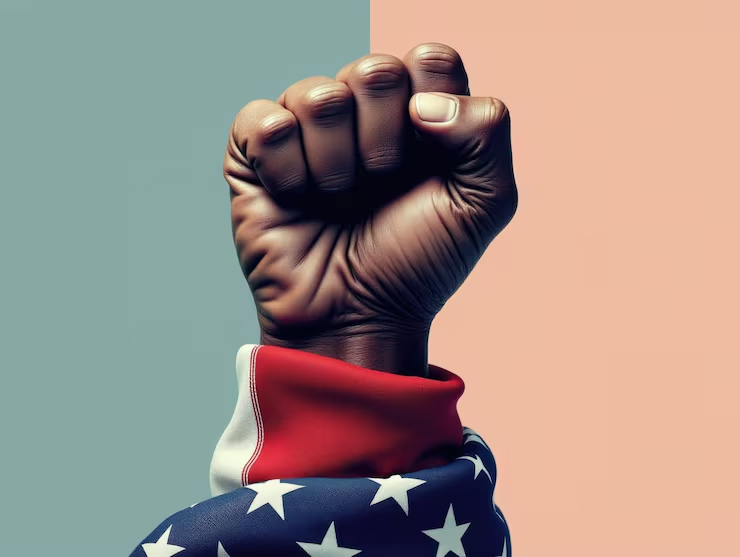
Let’s get on the same page when we think about POWER. It is one of the most important forces in life — and one of the most misunderstood or wrongly understood.
So, let’s fix this!
We live inside a vast invisible web I call The Power Mesh—a dynamic field of influence made up of leaders, followers, institutions, and systems. You’re in it every day — at work, in society, in politics.
Power is like electricity. you need to recognize, channel, and ground it — or it shocks, burns, or fades.
It’s an energy that takes many forms.
But here in the Power Mesh, power is a social, political, and psychological force. It operates between people. And it is a force inside us — with the potential to increase as our responsibilities increase and as we develop and mature throughout life.
As a leader or follower, in politics or business, are you aware of your power? How do you use and channel it? There is vast emotional, relational, institutional, and psychological power waiting for you to use —or to unconsciously give away or misuse.
Let’s debunk a myth:
Power in the Power Mesh isn’t a crown, a corner office, a loud voice, or a title. It is not tanks, guns, money. These are symbols and tools of power.
Rather, power is energy, not matter. It’s a process, not a possession. In mythology it is an invisible force for good or evil existing symbolically in light sabers (Star Wars), rings (Lord of the Rings), and wands (Harry Potter)!
You can actually feel this power when it is in play. I remember my first experience with “institutional” power over others. I was 10 years old. A “police girl” with a badge and a stop sign. I could stop traffic and signal kids to cross the street. When I put that badge on, I felt different. I wasn’t just a freckle faced kid with a leg brace and a name people couldn’t spell. I had power, stood taller, and felt its energy physically. In later
years during my work with leaders and as I helped others take on their own power, I remembered that feeling, that energy, and what it could do.
Years ago, I had a business partner who talked about a “freaky button” being pushed when power energy was in play. He recognized it as a feeling and tuned himself to detect it so he could use it or respond thoughtfully.
The first power skill is this:
👉 Recognize — feel — when power is in play.
At first glance, when people meet their institutional leaders in The Power Mesh, power can appear hopelessly asymmetric — unbalanced. People with titles who control resources and decisions have it, and others don’t.
Elected and appointed leaders have more of this institutional power, it is true —but they don’t have all the power.
Power always operates in relationships – given, taken, shared. “If you think you’re leading but no one is following, you’re just taking a walk.” (John C. Maxwell) I remember a cartoon years ago that showed a lone person chasing a large group. The caption?
Something like, “I must run to catch up, for I am their Leader!!”
Power is also a relationship with yourself. Think of your willpower battling it out with your desires in a power struggle. “Will I have this extra drink?,” Will I go to the gym?” “Will I get out of my comfort zone….” “Will I do the hard work to develop a new skill… prepare for a new role? …Case closed!
For too long, our institutions have treated power as a rational thing — something in a job description or contract. But it is juicier than that – a psychological, social, emotional, ofien irrational energy that follows its own rules – the rules of the Power Mesh.
From birth to elderhood, life is about claiming and expanding power—and learning to use it wisely.
We are designed to evolve from:
This isn’t about domination. It’s about agency, energy, and responsibility. We can use our inevitable struggles with power to sharpen our capabilities and open new doors. Or our uses of power can damage our spirit, shrink our character, or sour the legacy — whether as leader or led — of our one and only life.
Power requires vigilance, for its dynamics are ofien unconscious. As an elected or appointed leader, the moment you stop being aware of the workings of power around and in you, you’re an easy target for temptations to abuse that power. As a follower, you risk slipping into dependency. You may unwittingly stop growing as a powerful
and evolved human in your own right. Or you may collude in ways that erode your values and even self-respect.
In future articles, we’ll explore:
But for now, be alert. Notice. Feel when the power detector inside you activates:
Power is already in play. Right now. Inside you. Around you.
The question is: Are you using it—or is it using you?
Pat McLagan

Guiding leaders (and their followers) towards courageous action and ethical leadership.
Copyright © 2024 Patricia A McLagan, All Rights Reserved.
